
Choosing between education pathways can feel overwhelming, especially when deciding between diploma programs vs degrees. Both options offer valuable opportunities, but they differ in structure, duration, cost, and most importantly, career outcomes.
In Canada, particularly in Alberta, students are increasingly exploring alternatives to traditional university degrees. Many are choosing career training programs in Alberta that focus on practical skills, faster entry into the workforce, and job-ready training.
This blog will help you understand:
- The key differences between diploma programs and degrees
- How each option impacts career outcomes
- Which industries prefer each pathway
- Real-world examples and use cases
- How to choose the best option based on your goals
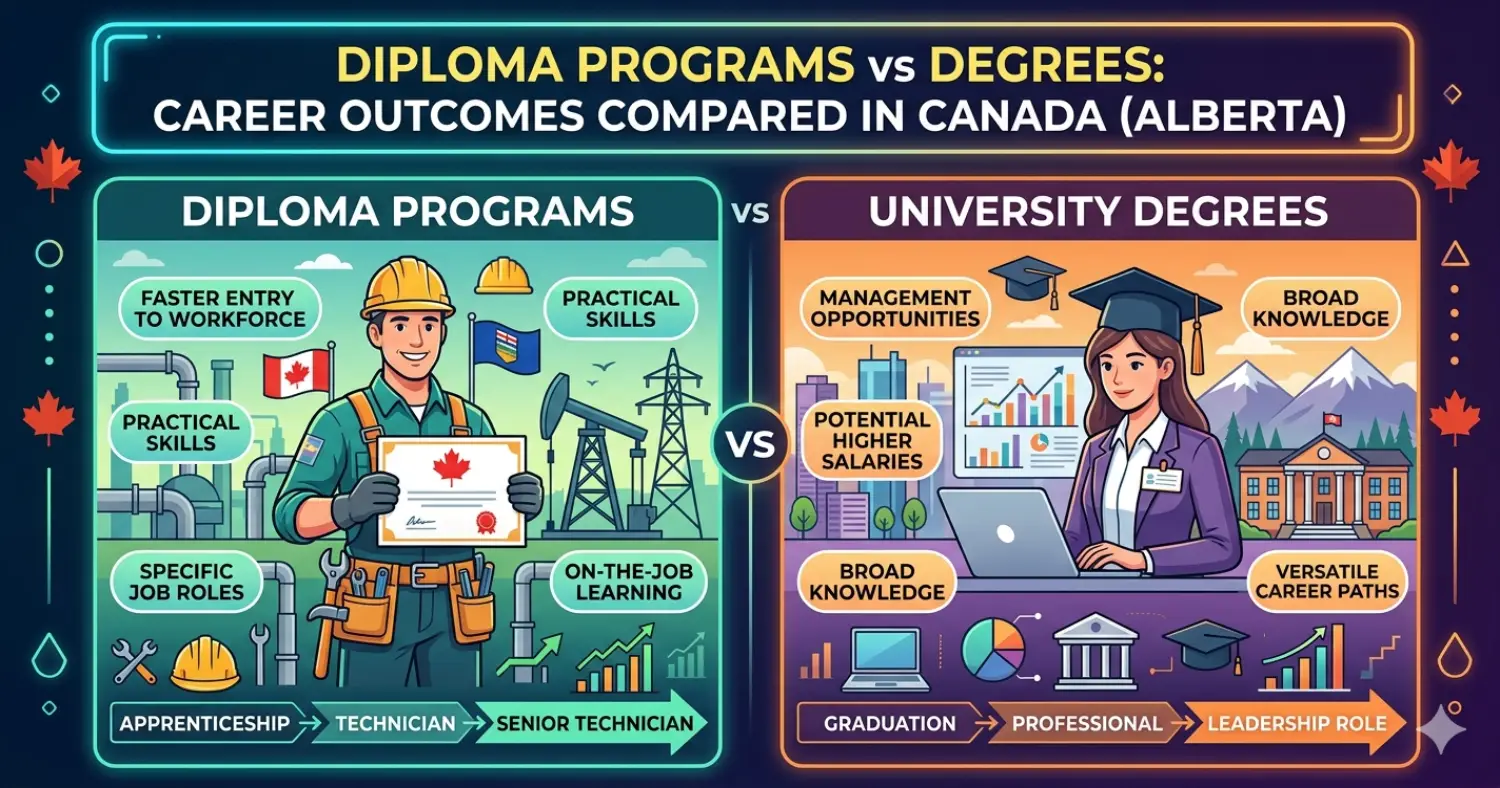
Understanding Diploma Programs vs Degrees
Before comparing outcomes, it is important to understand what each option involves.
What Are Diploma Programs?
Diploma programs are typically shorter, career-focused education options designed to prepare students for specific roles.
Key characteristics:
- Duration: 8 months to 2 years
- Focus on practical, job-ready skills
- Industry-aligned curriculum
- Hands-on learning and applied training
Diploma programs are commonly offered by career colleges and polytechnic institutions.
What Are Degrees?
Degrees are longer academic programs offered by universities.
Key characteristics:
- Duration: 3 to 4 years
- Broader theoretical education
- Focus on research and academic knowledge
- May include general education courses
Degrees are often required for professions such as engineering, law, or medicine.
Diploma Programs vs Degrees: Key Differences
Here is a clear comparison of diploma programs vs degrees in Alberta:
| Feature | Diploma Programs | Degrees |
| Duration | 8–24 months | 3–4 years |
| Focus | Practical, career-ready skills | Theoretical and academic knowledge |
| Cost | Lower overall cost | Higher tuition cost |
| Entry to workforce | Faster | Slower |
| Flexibility | Often focused on one career path | Broader academic exposure |
| Learning style | Hands-on and applied | Lecture-based with some practical elements |
Career Outcomes: Diploma Programs vs Degrees
When comparing diploma programs vs degrees, the most important factor for many students is career outcomes.
1. Speed of Employment
Diploma programs often lead to faster employment because they focus on job-ready skills.
Example:
A student completing a 40-week business diploma can enter the workforce much sooner than a student completing a 4-year degree.
Degrees may take longer but can lead to specialised or advanced roles.
2. Job Readiness
Employers often look for candidates who can contribute immediately.
Diploma graduates:
- Have practical experience
- Are familiar with workplace tools
- Can adapt quickly to job roles
Degree graduates:
- Have strong theoretical knowledge
- May require additional training to apply concepts
3. Salary Expectations
Salary outcomes vary depending on industry, role, and experience.
| Career Stage | Diploma Graduate | Degree Graduate |
| Entry Level | Competitive for technical roles | Competitive for corporate roles |
| Mid Career | Growth through experience | Growth through advancement |
| Long Term | Can reach similar levels with experience | Often higher in specialised fields |
In many industries, experience and skills matter more than the type of credential over time.
4. Career Flexibility
Degrees typically offer broader career flexibility because they cover a wide range of subjects.
Diploma programs offer:
- Focused career paths
- Direct entry into specific roles
Both pathways can lead to successful careers, depending on your goals.
Industries Where Diploma Programs Excel
Diploma programs are highly valued in industries that prioritise practical skills.
Examples include:
- Business administration
- Supply chain and logistics
- Healthcare support and wellness
- Information technology
- Skilled trades
Employers in these industries often prefer candidates who can perform tasks immediately.
Industries Where Degrees Are Preferred
Degrees are often required in fields that demand advanced theoretical knowledge or professional licensing.
Examples include:
- Engineering
- Medicine
- Law
- Academia
- Research-based roles
These careers require in-depth study and formal accreditation.
Real-World Use Cases
Understanding diploma programs vs degrees becomes easier when looking at real scenarios.
Use Case 1: Business Career
A student interested in business may choose:
- A diploma for quick entry into roles such as administrative assistant or marketing associate
- A degree for long-term roles in management or corporate leadership
Use Case 2: Career Change
An adult learner looking to change careers may choose a diploma program because:
- It is shorter
- It focuses on practical skills
- It allows faster entry into a new field
Use Case 3: Technical Roles
Many technical roles prioritise hands-on skills.
A diploma graduate trained in logistics or IT may be hired faster than a degree graduate without practical experience.
The Role of Hands-On Learning
One of the biggest advantages of diploma programs is hands-on learning.
Hands-on learning helps students:
- Practise real-world tasks
- Build confidence
- Develop job-ready skills
- Understand workplace expectations
This approach improves career outcomes by preparing students for real job environments.
Career Training Programs in Alberta: A Growing Trend
More students in Alberta are choosing career training programs in Alberta because they offer:
- Faster pathways to employment
- Practical, industry-focused training
- Lower tuition costs
- Flexible learning options
Career colleges such as the Professional Institute of Management and Technology (PIMT) provide diploma programs designed to align with employer expectations.
Diploma Programs at PIMT
PIMT offers career-focused diploma programs that prepare students for real-world roles.
These programs emphasize:
- Practical learning
- Industry-relevant curriculum
- Job-ready skills
- Personalized instruction
This type of education helps students transition smoothly into the workforce.
How to Choose Between Diploma Programs vs Degrees
When deciding between diploma programs vs degrees, consider the following:
1. Career Goals
Do you need a degree for your chosen profession, or can a diploma provide direct entry?
2. Time Commitment
Are you ready for a 3–4 year program, or do you prefer a shorter pathway?
3. Learning Style
Do you prefer hands-on training or academic study?
4. Financial Investment
Can you afford a longer, more expensive program?
5. Job Market Demand
Which industries are growing and what skills do employers need?
Key Advantages of Diploma Programs
- Faster entry into the workforce
- Practical and job-ready skills
- Lower cost
- Focused training
- Strong alignment with industry needs
Key Advantages of Degrees
- Broader academic knowledge
- Access to specialized professions
- Long-term career flexibility
- Opportunities for advanced education
Conclusion
The decision between diploma programs vs degrees depends on your goals, learning style, and career plans.
Diploma programs offer a fast, practical path into the workforce, making them ideal for students who want job-ready skills and quick employment. Degrees provide a broader academic foundation and are necessary for certain professions.
For many students in Alberta, career training programs in Alberta provide a strong balance between education and employment, helping them build skills that employers value.
By understanding your goals and evaluating your options carefully, you can choose the pathway that best supports your future success.
FAQs
-
What is the main difference between diploma programs vs degrees?
Diploma programs focus on practical, job-ready skills and are shorter, while degrees provide broader academic knowledge and take longer to complete.
-
Which is better diploma programs vs degrees?
It depends on your career goals. Diplomas are ideal for quick employment, while degrees are better for specialized professions.
-
Are diploma programs recognized in Canada?
Yes. Many employers value diploma programs, especially in industries that require practical skills.
-
Do diploma graduates get jobs faster?
Often yes. Diploma programs are designed to prepare students for immediate entry into the workforce.
-
Are degrees more expensive than diplomas?
Generally, degrees cost more due to longer program duration and university tuition fees.
-
Can diploma holders earn high salaries?
Yes. With experience, diploma graduates can achieve competitive salaries in many industries.
-
Do employers prefer diplomas or degrees?
It depends on the job. Some roles require degrees, while others prioritize practical skills from diploma programs.
-
What industries prefer diploma graduates?
Industries such as business, logistics, healthcare support, and IT often prefer diploma graduates with practical skills.
-
Can I upgrade from a diploma to a degree?
Yes. Many students use diplomas as a pathway to further education.
-
Are career training programs in Alberta worth it?
Yes. They provide practical skills, faster employment opportunities, and industry-focused education.
-
How long do diploma programs take in Alberta?
Most diploma programs take between 8 months and 2 years depending on the field.
-
Do degrees guarantee better career outcomes?
Not always. Career outcomes depend on skills, experience, and industry demand.
-
How can I contact PIMT for more information?